
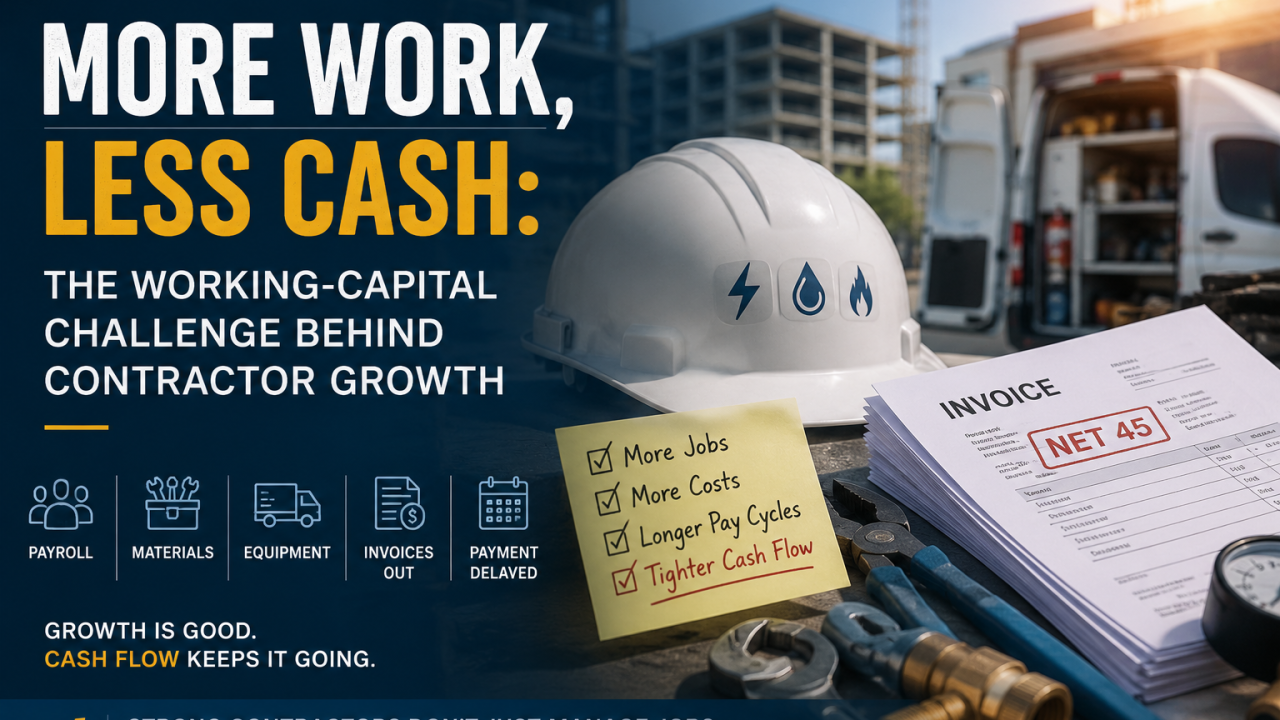
The Working-Capital Challenge Behind Contractor Growth
For electricians, plumbers, and HVAC contractors, more work should be good news.
More service calls, larger projects, maintenance contracts, renovation work, and commercial assignments can create stronger revenue and long-term growth.
But there is a financial reality that many growing contractors eventually encounter:
The more work a company wins, the more pressure it can place on cash flow.
This is especially true for contractors serving commercial property owners, banks, mortgage servicers, property managers, restoration companies, government agencies, general contractors, and other institutional customers.
The contractor may complete the work today and wait 30, 45, or 60 days to be paid.
Payroll, suppliers, fuel, insurance, equipment vendors, and subcontractors usually do not wait nearly as long.
The result can be a company that looks profitable on paper while struggling to generate enough available cash to comfortably finance its next project.
Growth Creates a Working-Capital Requirement
Every new job requires resources before it produces collected cash.
An electrical contractor may need wire, panels, fixtures, lifts, permits, tools, and additional labor.
A plumbing company may need piping, valves, water heaters, fixtures, excavation services, or emergency equipment.
An HVAC contractor may need compressors, furnaces, rooftop units, refrigerant, ductwork, controls, or additional installation crews.
Those costs often have to be paid before the contractor receives payment from the customer.
The challenge becomes more pronounced when several assignments arrive at once or when the company wins a larger commercial relationship.
In other words:
Growth itself has to be financed.
And the faster the company grows, the larger that financing requirement may become.
Profitability and Liquidity Are Not the Same Thing
This is one of the most important financial distinctions for a growing contractor.
A business can be profitable and cash constrained at the same time.
Suppose a plumbing contractor completes $100,000 of profitable work.
The revenue may appear on the company’s financial statements, and the invoices may be sitting in accounts receivable.
But if the customer will not pay for another 45 days, that receivable cannot make this week’s payroll or purchase materials for tomorrow’s job.
The company may have earned the money without having collected the money.
That does not necessarily indicate a weak business.
In many cases, it means the company’s access to capital has not kept pace with its sales.
When Growth Starts Straining the Business
The warning signs often appear operationally before they become obvious on the financial statements.
A contractor may begin:
- Using personal credit cards for materials • Delaying payments to suppliers or subcontractors • Putting personal funds into the business more frequently • Postponing equipment or vehicle purchases • Struggling to fund weekly payroll • Reaching the limit on an existing bank line • Carrying larger balances with supply houses • Accumulating substantial receivables while maintaining little available cash • Turning down profitable projects
That last point is particularly important.
A contractor who cannot finance a project may decline the work even when the job itself would be profitable.
The cost can extend well beyond the margin on one project.
Turning down work can affect customer relationships, geographic expansion, preferred-vendor opportunities, referrals, reputation, and future contracts.
That leads to a useful question for any growing contractor:
Are we turning down good work because we lack the cash to perform it?
If the answer is yes, demand may not be the problem.
Capital capacity may be.
Hiring Also Requires Capital
Adding employees can create another cash-flow challenge.
A new technician may require several weeks of payroll before the revenue generated by that employee is actually collected.
The real cost can also include:
- A service vehicle • Tools and safety equipment • Uniforms • Licensing or certification • Training • Insurance • Dispatch and technology access • Inventory and commonly used parts
That is why hiring plans should be connected to capital planning.
The relevant question is not simply, “Can we afford this employee’s wage?”
It is:
How much cash will we need to recruit, equip, insure, train, and support this employee until the resulting revenue is collected?
Protect Working Capital When Buying Equipment
Contractors also have to make thoughtful decisions about vehicles, machinery, tools, and specialized equipment.
Paying cash for every asset can feel conservative.
But using a large portion of available cash to purchase a truck or major piece of equipment may leave the company with less liquidity for payroll, materials, and new projects.
In some situations, financing an asset can help match its cost with the period during which it generates revenue.
That does not mean every equipment purchase should be financed.
The right decision depends on the purchase price, useful life, financing cost, cash reserves, expected revenue, and overall financial condition of the business.
The broader principle is simple:
Do not sacrifice short-term operating stability simply to avoid financing a long-term productive asset.
Match the Financing to the Business Need
There is no single financing product that is right for every contractor.
Different problems require different capital structures.
A business line of credit may be useful for recurring short-term needs such as payroll, materials, project startup costs, or seasonal fluctuations.
Receivables financing or invoice factoring may be worth evaluating when the company has eligible commercial invoices from financially strong customers that pay slowly.
Equipment financing may help fund service vehicles, machinery, lifts, diagnostic equipment, trailers, and other revenue-producing assets.
Term financing may make sense for a defined strategic initiative such as opening another location, acquiring a contractor, upgrading technology, or developing a new service department.
Qualified companies may also evaluate SBA-supported financing, asset-based lending, or commercial real estate financing depending on their circumstances.
Larger or rapidly growing companies may ultimately need more than one source of capital.
For example, an HVAC contractor might finance vehicles and equipment separately while maintaining a line of credit for payroll and materials.
The goal is not simply to obtain financing.
The goal is to match the source of capital with the business purpose it is intended to support.
Build a Capital Strategy Before You Need One
Too many companies begin looking for financing only after the pressure becomes urgent.
Payroll is approaching.
A large equipment purchase becomes necessary.
A major new contract has been awarded.
Or an important customer pays later than expected.
A stronger approach is to think about capital before the business reaches that point.
Contractors can improve their financing readiness by maintaining current financial statements, tax returns, bank statements, accounts-receivable and accounts-payable aging reports, equipment and debt schedules, major contracts, and realistic cash-flow forecasts.
They should also understand:
- How quickly their customers pay • Which projects generate the strongest margins • How much working capital new contracts require • What equipment will need replacement • When they expect to hire • How seasonality affects cash requirements • How much liquidity they want to maintain
Financing becomes much easier to evaluate when management knows exactly what the capital is intended to accomplish and how it will ultimately be repaid.
The Bigger Question
A growing backlog should be an opportunity.
It should not become the reason a contractor is constantly worried about payroll, materials, vehicles, or slow-paying customers.
For electricians, plumbers, and HVAC contractors experiencing rapid growth, the financial question is not simply:
“How much can we borrow?”
A better question is:
“What capital structure will allow this business to pursue profitable opportunities while maintaining enough liquidity to operate safely?”
Revenue growth matters.
Profitability matters.
But sustainable growth also requires the financial capacity to perform the work before the cash from that work arrives.
For contractors with strong demand, making sure capital keeps pace with opportunity may be one of the most important parts of the growth strategy.
WorkingCapital #ContractorGrowth #CashFlowManagement #ConstructionFinance #BusinessGrowth #UpFinityConsulting #UpFinity CapitalpFinity Capital