
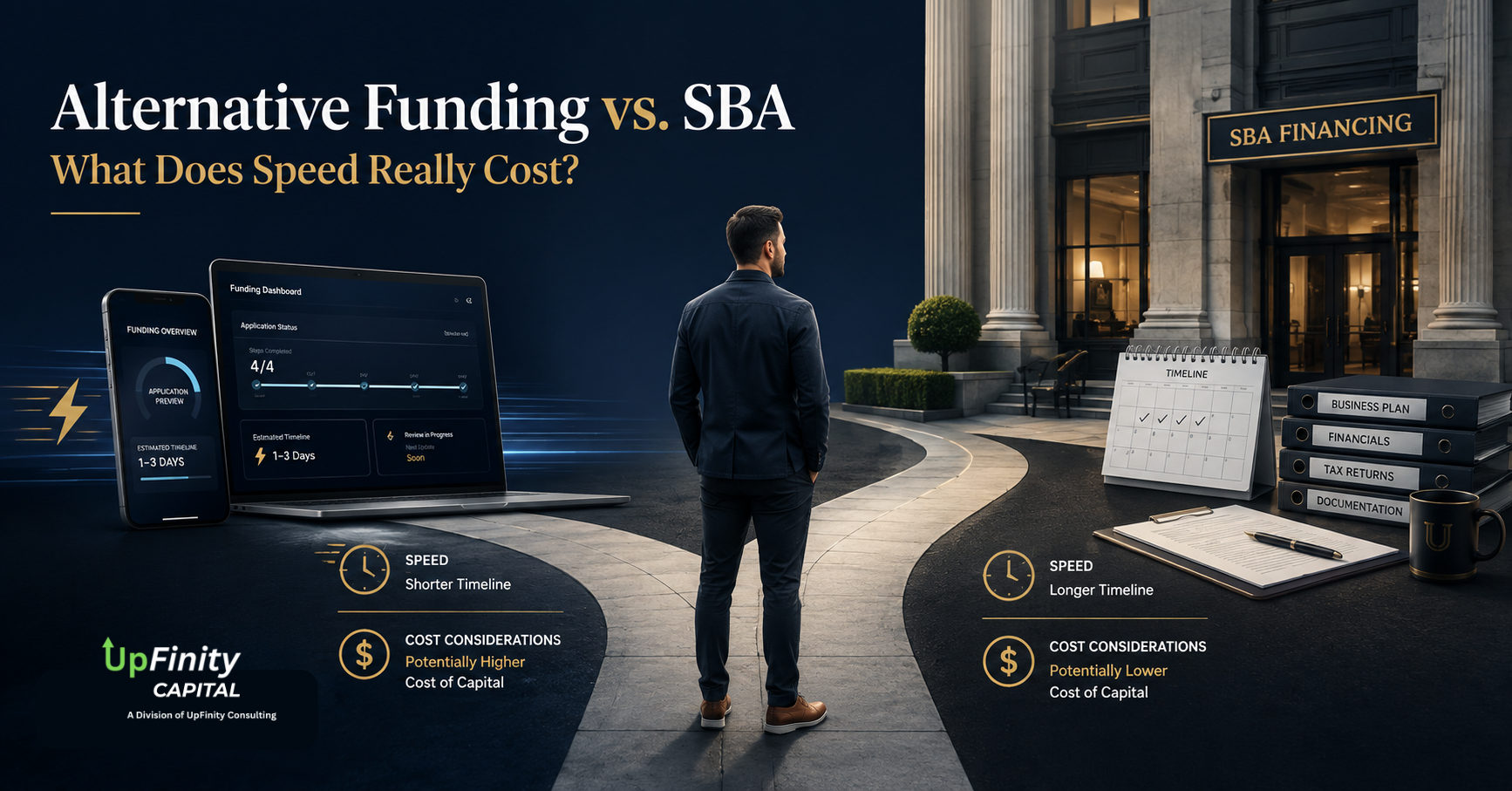
A restaurant owner recently faced a choice many business owners eventually encounter.
The business needed capital quickly.
One option could potentially provide access to working capital much faster. The other, an SBA-backed loan, offered the possibility of a lower cost of capital—but required more documentation and a longer process.
The owner chose speed.
In the end, the faster financing carried a significantly higher cost than the SBA option might have carried.
Was that a mistake?
Not necessarily.
The better question is:
Was the time saved worth the additional cost?
That is the question business owners should be asking when comparing alternative funding vs. SBA loans.
Because in business funding, speed has a price.
And sometimes paying that price makes sense.
Sometimes it does not.
Alternative Funding vs. SBA Loans: The Basic Tradeoff
Business financing rarely comes down to one option being universally “better.”
Different funding options solve different problems.
An SBA-backed loan may offer attractive long-term financing for qualified businesses, but the process can involve more documentation, underwriting, and preparation.
Alternative funding may offer a more streamlined process and potentially faster access to capital, but that convenience can come with a higher overall cost.
At a high level, the tradeoff often looks like this:
| Factor | SBA Financing | Alternative Funding |
|---|---|---|
| Speed | Typically slower | Often faster |
| Documentation | More extensive | Often streamlined |
| Cost of capital | Often lower for qualified borrowers | Can be higher |
| Repayment period | Often longer | Often shorter |
| Underwriting | More detailed | May be more flexible |
| Best suited for | Planned, long-term financing | Time-sensitive working capital needs |
Actual terms, eligibility, timing, and pricing vary by funding provider and borrower and are subject to underwriting.
The important point is that speed and cost are often connected.
Why Faster Alternative Funding Can Cost More
Traditional financing generally requires more time to evaluate risk.
Financial institutions may review items such as:
- Business and personal credit
- Tax returns
- Profit-and-loss statements
- Balance sheets
- Existing debt obligations
- Cash flow
- Ownership history
- Business plans or projections
- Collateral, depending on the financing structure
That process takes time.
Alternative funding providers may use different underwriting methods, place more emphasis on recent business performance, or consider business profiles that may not fit traditional lending criteria.
When a funding provider assumes more risk or delivers a more streamlined process, the pricing may reflect that additional risk and convenience.
Think of it as a speed premium.
You are not simply paying for access to capital.
You may also be paying for faster access to that capital.
A Simple Example of the “Speed Premium”
Consider a hypothetical business seeking $150,000.
Suppose the owner has two potential paths.
Option A: SBA Financing
The business may qualify for longer repayment terms and a lower annualized borrowing cost.
But the process may take several weeks depending on the lender, borrower documentation, deal complexity, and underwriting.
Option B: Alternative Working Capital Funding
The business may receive a decision and potentially access funding much sooner.
However, the overall financing cost may be substantially higher.
For illustration, imagine the faster option costs the business an additional $20,000 to $30,000 compared with the alternative SBA structure.
That additional cost sounds expensive.
And it is.
But the calculation is not finished yet.
The owner should now ask:
What does waiting cost the business?
The Cost of Capital vs. the Cost of Waiting
This is where many business owners make the wrong comparison.
They compare financing costs but ignore the economics of the opportunity they are trying to fund.
Imagine a contractor wins a large project.
The project requires:
- $80,000 in materials
- Additional employees
- Equipment rentals
- Insurance expenses
- Payroll before the first customer payment arrives
The project could potentially generate $250,000 in revenue.
If waiting six weeks for financing means losing the contract, then paying more for faster capital may be financially rational.
The extra financing cost should be compared against the profit opportunity at risk, not simply against another financing option’s interest rate.
The same logic can apply when a business needs money for:
- Inventory before a peak season
- Emergency equipment replacement
- Payroll
- A large customer order
- A new location
- Vendor discounts
- Marketing tied to a time-sensitive opportunity
- Acquisition opportunities
- Expansion projects
In those situations, speed itself can have economic value.
When an SBA Loan May Be the Better Choice
If your business has time to prepare, SBA financing may be worth exploring.
It can be especially attractive when the capital will support a long-term investment.
Buying commercial real estate
Long-lived assets generally pair better with longer-term financing than short-term capital.
Purchasing major equipment
If equipment will generate revenue for years, stretching repayment over a longer period may help preserve monthly cash flow.
Acquiring another business
Business acquisitions often require careful underwriting and financial analysis, making the additional preparation worthwhile.
Refinancing eligible debt
Lower-cost financing may improve cash flow when the transaction qualifies.
Funding a planned expansion
If you know months in advance that you intend to open another location, waiting until the last minute for capital can unnecessarily limit your options.
The key word is planned.
The more time you give yourself, the more funding options you may be able to evaluate.
When Alternative Funding May Make Sense
There are also situations where waiting could cost more than borrowing.
A revenue opportunity has a deadline
A supplier offers discounted inventory this week.
A customer awards you a large contract.
A commercial property becomes available.
The window may close before traditional financing can be completed.
Equipment failure is stopping revenue
If a restaurant loses refrigeration equipment or a manufacturer loses a critical machine, every day without a replacement could mean lost sales.
In that situation, speed may matter more than securing the lowest possible financing cost.
Payroll cannot wait
Businesses with long customer payment cycles—such as staffing, logistics, healthcare, contracting, and other service businesses—may need working capital before receivables arrive.
You are managing a temporary cash-flow gap
A profitable business can still experience timing problems when expenses arrive before customer payments.
Alternative working capital may sometimes help bridge that gap.
The question is whether the business generates enough economic benefit from the capital to justify its cost.
Don’t Compare Payments. Compare Total Economics.
One of the biggest mistakes business owners make is comparing only the payment amount.
A financing offer with a manageable weekly payment is not automatically cheaper.
A loan with a low monthly payment is not automatically the better option either.
Before choosing financing, evaluate at least five things.
1. Total repayment
How much will the business repay in total if the financing runs its full course?
2. Annualized cost
When possible, understand the effective annual cost of the financing so different funding options can be compared more fairly.
3. Payment frequency
Is repayment:
- Daily?
- Weekly?
- Monthly?
Payment frequency can significantly affect operating cash flow.
4. Prepayment structure
Ask whether paying early reduces the remaining financing cost.
Some products offer meaningful savings for early payoff.
Others may not.
5. Opportunity value
What will the capital allow the business to earn, save, protect, or avoid losing?
That last number can completely change the decision.
A Better Formula for Choosing Business Funding
Instead of asking:
“Which financing option is cheapest?”
Try asking:
“Which funding option creates the strongest economic outcome for my business?”
A simple framework is:
Expected financial benefit from the capital
minus
Total financing cost
minus
Risk created by the repayment structure
equals
Potential economic value
For example:
A business pays $20,000 more for faster capital.
But receiving the funds quickly allows it to complete a project expected to generate $75,000 in gross profit.
The faster funding may still make sense.
On the other hand, if the owner is borrowing quickly simply because they failed to plan for an expense that will not generate additional revenue, paying a large speed premium may be difficult to justify.
Same type of capital.
Completely different business decision.
The Best Time to Look for Funding Is Before You Need It
Business owners usually lose negotiating power when funding becomes an emergency.
If payroll is Friday and the bank account is short Thursday morning, speed becomes the only priority.
That makes it difficult to compare funding options carefully.
Instead, businesses should consider building a funding strategy before capital becomes urgent.
That could include:
- Monitoring business and personal credit
- Maintaining accurate financial statements
- Reviewing cash-flow forecasts
- Understanding upcoming capital expenditures
- Building banking relationships
- Establishing business credit
- Maintaining available lines of credit where appropriate
- Reviewing funding options before expansion begins
Preparation creates options.
And more options usually create better financial decisions.
SBA vs. Alternative Funding: Which Should You Choose?
There is no universal answer.
An SBA loan may be worth pursuing when:
- You qualify
- Your financing need is planned
- You have time for underwriting
- Long-term repayment is important
- Minimizing financing cost is a priority
Alternative funding may be worth considering when:
- The opportunity is time-sensitive
- Waiting could create a larger financial loss
- Cash flow needs are immediate
- Traditional financing does not match the situation
- The expected return from using the capital may justify the higher cost
Neither category should automatically be viewed as “good” or “bad.”
They are financial tools.
The goal is to match the right tool to the right business situation.
Before You Pay for Speed, Calculate What the Time Is Worth
When comparing alternative funding vs. SBA loans, the biggest mistake is focusing only on the headline rate or how quickly capital may become available.
You need both sides of the equation.
Ask:
What will this financing cost me?
Then ask:
What could waiting cost me?
If waiting six weeks saves $25,000 in financing costs but causes you to lose a $100,000 profit opportunity, waiting may be expensive.
If there is no urgent opportunity and the business has time to qualify for lower-cost financing, paying a premium for speed may be unnecessary.
That is why funding decisions should start with strategy—not urgency.
Talk With Upfinity Capital Before You Choose a Funding Option
Upfinity Capital helps business owners evaluate funding options based on their goals, cash flow, timeline, and overall funding readiness.
Instead of starting with one product, the goal is to understand:
What are you trying to accomplish with the capital—and what financing structure makes sense for that objective?
Depending on your business profile, you may qualify for different funding options. All financing is subject to underwriting and applicable eligibility requirements.
Explore your potential business funding options with Upfinity Capital:
Frequently Asked Questions
Are SBA loans cheaper than alternative funding?
For many qualified borrowers, SBA-backed financing may offer a lower annualized cost of capital than certain alternative funding products. However, actual pricing depends on the financing structure, provider, borrower qualifications, term, fees, and underwriting.
How long does an SBA loan take?
Timelines vary significantly based on the SBA program, lender, loan complexity, documentation, and borrower preparedness. SBA financing generally requires more documentation and underwriting than many alternative funding options.
Is alternative funding bad for a business?
No. Alternative funding can be useful when a business values speed, requires flexibility, or has a time-sensitive capital need. The important issue is whether the expected business benefit justifies the financing cost and repayment structure.
Is faster business funding always more expensive?
Not always, but speed, underwriting flexibility, and risk can influence pricing. Business owners should compare total repayment, payment schedule, annualized cost, prepayment terms, and the expected return from using the funds.
Should I pursue an SBA loan or alternative working capital?
It depends on the purpose of the capital, how quickly you need it, your qualifications, your desired repayment structure, and the economics of the opportunity. Evaluating multiple funding options can help you make a more informed decision.
Educational Disclaimer: This article is for general educational purposes only and does not constitute financial, legal, or tax advice. Financing availability, amounts, rates, terms, and approval are subject to underwriting and may vary based on the applicant and funding provider.