Why a Bank “No” Should Not End the Financing Conversation
Winning a major contract, adding a large customer, expanding into a new location, or acquiring a competitor should be signs that a business is moving in the right direction.
Yet these positive developments can create an unexpected financial problem:
The company may need substantial cash before the opportunity begins producing cash.
Employees must be paid. Materials must be purchased. Equipment may need to be acquired. Suppliers and subcontractors expect payment. New locations require deposits, inventory, technology, insurance, and operating support.
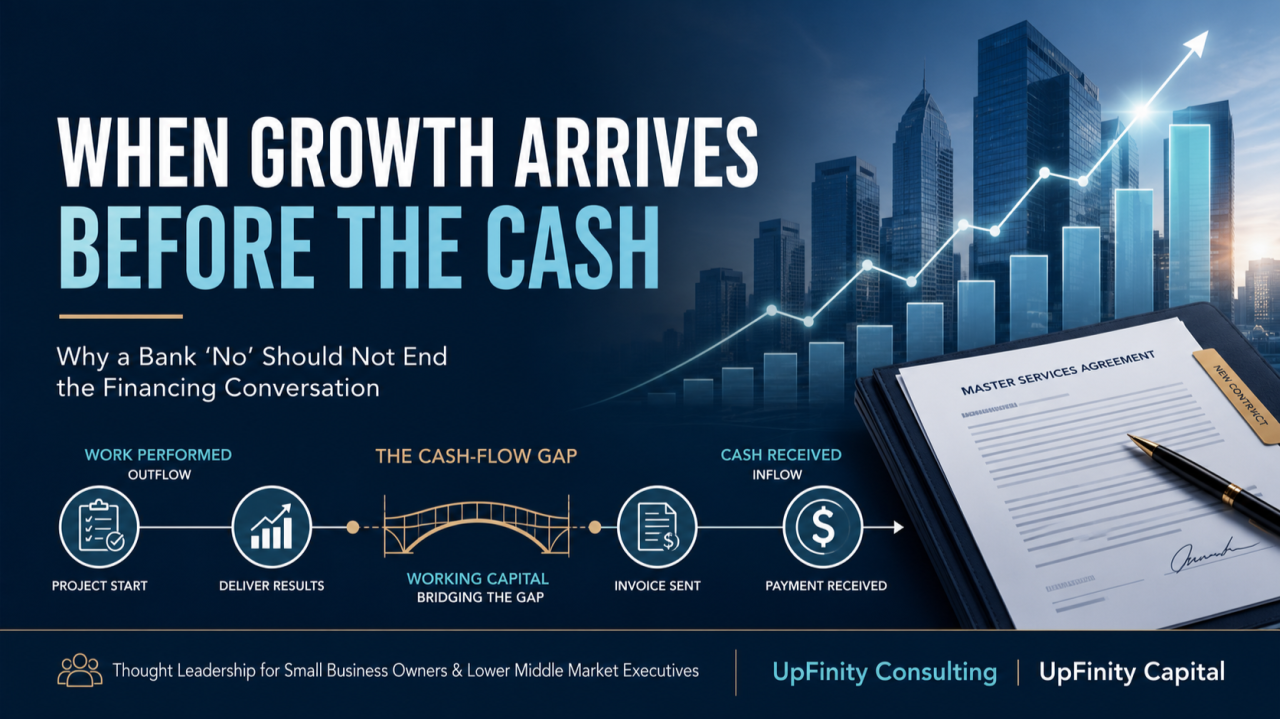
Meanwhile, the customer may not pay for 30, 60, 90, or even more days.
The result is one of the most misunderstood challenges in business finance:
A company can be growing, profitable, and commercially viable—while becoming less liquid.
For small business owners and lower middle market executives, understanding this distinction can mean the difference between turning down an important opportunity and finding an appropriate way to fund it.
The Cash-Flow Problem Hidden Inside Good News
Consider a service company that wins a large commercial contract.
To perform the work, the company may need to hire additional employees immediately, purchase supplies, add vehicles, increase insurance coverage, and absorb several weeks of payroll and operating expenses.
The contract may be profitable.
The customer may be financially strong.
The company may be fully capable of doing the work.
But if the customer requires extended payment terms, the business must finance the time between performing the service and collecting the receivable.
That is not necessarily a profitability problem.
It is a cash-conversion-cycle problem.
A recent case study published illustrates this through a commercial cleaning company that had grown from a one-person operation to more than 20 active clients. A prospective contract covering 11 fast-food locations and two full-service restaurants required the company to add eight or nine employees while accepting 60-day payment terms. The opportunity was attractive, but the first customer payment might not arrive for nine or ten weeks.
In circumstances like these, the wrong question is:
“Why doesn’t this company have enough money?”
A better question is:
“What must the company pay before its customer pays it?”
That question changes the financing conversation from one centered on financial distress to one centered on transaction timing, working capital, and growth capacity.
Why Traditional Bank Financing May Not Fit Every Opportunity
Traditional banks remain essential to the financial system and are often the best source of capital for businesses that meet their underwriting standards.
However, banks generally evaluate more than the quality of a new contract or the strength of a company’s opportunity. They may also consider historical profitability, debt-service coverage, collateral, leverage, owner credit, liquidity, time in business, industry risk, borrowing history, and the strength of any personal guarantee.
A business can therefore have a legitimate financing need and still fall outside a bank’s credit parameters.
The latest Federal Reserve Small Business Credit Survey illustrates the difficulty. Only 52% of financing applicants received the full amount they requested in 2024, remaining below pre-pandemic approval levels. Among applicants, full approval rates were approximately 54% at small banks, 45% at large banks, and 30% at online lenders.
The same Federal Reserve research found that 39% of small employer firms carried more than $100,000 in debt, compared with 31% in 2019. Among businesses denied financing, 41% reported that elevated debt was a reason for the denial, nearly double the 22% reported in 2021.
These figures do not mean that traditional lenders are failing businesses. They show that lender underwriting requirements and business operating realities do not always align.
A bank may decline a request because:
- The business lacks sufficient historical cash flow.
- Existing debt is already high.
- The collateral does not support the requested amount.
- The company is growing faster than its financial statements can demonstrate.
- The owner’s credit profile does not satisfy policy.
- The financing purpose falls outside the bank’s risk appetite.
- The business needs capital faster than the bank’s process allows.
- The repayment structure does not fit the company’s cash cycle.
- The request is too specialized, complex, or transaction-dependent.
In other cases, the bank may approve only part of the amount needed.
For the business owner, the practical result is the same: an important growth opportunity remains underfunded.
The Financing Challenge Is Not Limited to Small Businesses
Lower middle market companies face similar issues, although the transactions are often larger and more complex.
The National Center for the Middle Market defines the broader U.S. middle market as companies generating between $10 million and $1 billion in annual revenue. Nearly 200,000 companies fall within this range, collectively representing approximately one-third of private-sector GDP and employing about 48 million people.
At midyear 2025, 84% of surveyed middle market companies reported year-over-year revenue growth. However, growth rates had slowed, economic uncertainty remained elevated, and executives continued balancing investment needs against inflation, tariffs, margin pressure, and changing market conditions.
Lower middle market companies may seek financing to support:
- Acquisitions and ownership transitions.
- New facilities or geographic expansion.
- Large customer contracts.
- Seasonal working-capital needs.
- Equipment and technology investments.
- Inventory purchases.
- Recapitalizations.
- Refinancing or restructuring existing debt.
- Management buyouts.
- Turnaround or special situations.
- Partner buyouts.
- Growth that exceeds the capacity of an existing bank line.
These companies may have meaningful revenue, strong management teams, and established operations, yet still require financing structures that are more flexible than conventional bank credit.
Research from the National Center for the Middle Market indicates that private credit has increasingly filled this role. Among surveyed private-equity-owned middle market companies, 84% used one or more forms of private credit. Executives cited customized structures and the willingness to finance riskier or nontraditional uses as important advantages.
Alternative Financing Is Not One Product
The term alternative financing covers a broad range of nontraditional funding structures. The appropriate solution depends on why the capital is needed, how repayment will occur, what assets are available, and how quickly the business requires funding.
Possible alternatives include:
Invoice factoring: Converts qualifying business-to-business or government receivables into working capital rather than requiring the company to wait for customers to pay.
Asset-based lending: Establishes a revolving credit facility supported by eligible assets such as accounts receivable, inventory, equipment, or, in some structures, real estate.
Purchase-order financing: May help fund supplier or production costs associated with confirmed customer orders.
Equipment financing or leasing: Aligns the financing with the useful life and value of equipment being acquired.
Non-bank business lines of credit: Can provide flexible access to working capital, although cost, term, repayment frequency, and renewal conditions vary considerably.
SBA financing through bank and non-bank participants: May support acquisitions, real estate, equipment, refinancing, and longer-term business needs for qualifying companies.
Private credit: Can provide customized senior, unitranche, second-lien, mezzanine, acquisition, or growth financing for established middle market companies.
Commercial real estate and bridge financing: May support acquisitions, renovations, construction transitions, refinancing, or time-sensitive real estate transactions.
Revenue-based financing and other cash-flow structures: Base repayment partly on business revenue or cash generation rather than relying exclusively on traditional collateral.
Merchant cash advances: Provide fast access to capital but may carry high costs, frequent payments, and complex contractual terms. They should be evaluated carefully and generally not treated as interchangeable with conventional loans or longer-term working-capital facilities.
The existence of these products does not mean every one is appropriate for every business.
The objective should not be to find just any source of money.
The objective should be to find a financing structure that supports the business purpose without creating a larger problem later.
Start With Transaction, Timing, and Terms
Before evaluating products, business owners and executives should examine three elements.
Transaction
What specific opportunity or business requirement is creating the need?
Is the company funding a contract, acquisition, expansion, equipment purchase, inventory build, real estate transaction, ownership transition, or temporary working-capital gap?
Timing
When must the company spend the money, and when will the investment begin generating cash?
A profitable transaction can still fail if payroll, suppliers, or acquisition expenses must be funded months before cash becomes available.
Terms
How will the financing be repaid?
Will repayment come from receivable collections, operating cash flow, asset sales, recurring revenue, refinancing, or proceeds from a future transaction?
Matching the financing to these three elements is far more effective than selecting a product based primarily on speed or advertised payment size.
What to Seek in a Trusted Capital Advisor
A capable advisor should do more than forward an application to the first available funding source.
The advisor should begin by understanding the business.
That includes the company’s history, management team, revenue model, customers, industry, existing debt, collateral, cash-flow cycle, financing purpose, risks, and strategic objectives.
Business owners and executives should seek an advisor who:
- Asks about the underlying business objective before recommending a product.
- Explains the differences among loans, factoring, asset-based lending, private credit, and transaction-specific financing.
- Evaluates the total cost of capital—not merely the payment amount.
- Discusses fees, guarantees, collateral, covenants, prepayment provisions, and renewal requirements.
- Identifies potential risks and disadvantages, not only benefits.
- Has access to multiple funding sources rather than one preferred product.
- Understands when a conventional bank remains the best option.
- Can coordinate with the company’s CPA, attorney, banker, insurance advisor, and other professionals.
- Protects confidential information and avoids unnecessarily distributing financial documents.
- Does not promise approval, terms, or closing dates before underwriting is complete.
- Helps management consider whether the financing supports the company’s broader strategy.
The best capital advisors are not simply selling money.
They are helping leadership determine:
How much capital is needed?
What form should it take?
What will it cost?
What risks will it create?
And will it improve the company’s position after the transaction is complete?
A Bank Decline Is Information—Not Necessarily a Verdict
A traditional bank’s decision should be taken seriously.
It may expose an important weakness involving leverage, profitability, collateral, liquidity, or financial reporting. Those issues should not be ignored.
But a bank decline does not always mean the business is unfinanceable.
It may mean:
- The request does not fit that bank’s policy.
- The need is better supported by receivables or other assets.
- The transaction requires specialized underwriting.
- The business needs a different repayment structure.
- The company should combine financing sources.
- The request should be repositioned around its economic purpose.
- Management needs to strengthen the company’s capital readiness before reapplying.
In the case study, the cleaning company began factoring approximately $100,000 per month in existing invoices. If it secured the new contract, monthly invoice volume was expected to increase by roughly 30% to 40%. More importantly, access to working capital gave the owner confidence to consider future commercial and government contracts that extended payment terms might previously have placed beyond reach.
The financing did more than address a temporary cash shortage.
It increased the company’s capacity to pursue profitable growth.
The Question Every Business Leader Should Ask
Before rejecting a contract, postponing an acquisition, delaying an expansion, or assuming that a bank decline has ended the opportunity, ask:
Is the business facing a fundamental performance problem—or does it have a financing structure that no longer matches the opportunity?
Those are very different situations.
One may require operational correction.
The other may require a better-aligned capital strategy.
Call to Action
If your company is turning down profitable work, delaying expansion, carrying substantial receivables, operating with an undersized bank line, or preparing for a transaction that conventional financing cannot fully support, do not begin by searching for the fastest available money.
Begin with a disciplined review of the business objective, timing, cash-flow impact, repayment source, and range of available structures.
UpFinity Consulting helps business owners and lower middle market executives evaluate the strategic, operational, and financial considerations surrounding growth and change.
UpFinity Capital helps companies and their trusted advisors explore commercial financing options when traditional banks cannot, will not, or cannot fully satisfy the financing requirement.
A financing conversation does not guarantee approval—and not every opportunity should be financed.
But the right conversation may reveal that the obstacle is not the quality of the business opportunity.
It is the need for a capital structure capable of supporting it.
Before declining the opportunity, determine whether a better financing strategy could make it possible.
#BusinessFinancing #WorkingCapital #CashFlow #AlternativeLending #SmallBusiness #MiddleMarket #BusinessGrowth #CapitalStrategy #UpFinityCapital #UpFinityConsulting